Showing posts with label Mazars in Pakistan. Show all posts

Friday, 20 July 2012

Bulleh Shah (1680 - 1758)

Mir Bulleh Shah Qadiri Shatari, often referred to simply as Bulleh Shah (a shortened form of Abdullah Shah) lived in what is today Pakistan. His family was very religious and had a long tradition of association with Sufis. Bulleh Shah's father was especially known for his learning and devotion to God, raising both Bulleh Shah and his sister in a life of prayer and meditation.

Bulleh Shah himself became a respected scholar, but he longed for true inner realization. Against the objections of his peers, he became a disciple of Inayat Shah, a famous master of the Qadiri Sufi lineage, who ultimately guided his student to deep mystical awakening.


The nature of Bulleh Shah's realization led to such a profound egolessness and non-concern for social convention that it has been the source of many popular comical stories -- calling to mind stories of St. Francis or Ramakrishna. For example, one day Bulleh Shah saw a young woman eagerly waiting for her husband to return home. Seeing how, in her anticipation, she braided her hair, Bulleh Shah deeply identified with the devoted way she prepared herself for her beloved. So Bulleh Shah dressed himself as a woman and braided his own hair, before rushing to see his teacher, Inayat Shah.

Bulleh Shah is considered to be one of the greatest mystic poets of the Punjab region.

His tomb in the Qasur region of Pakistan is greatly revered today.


Poems by Bulleh Shah
Bulleh! to me, I am not known
He Who is Stricken by Love
I have been pierced by the arrow of love, what shall I do ?
I have got lost in the city of love
If the divine is found through ablutions
Look into Yourself
Love Springs Eternal
One Point Contains All
One Thread Only
Remove duality and do away with all disputes;
Repeating the name of the Beloved
The soil is in ferment, O friend
this love -- O Bulleh -- tormenting, unique
What a carefree game He plays!
You alone exist; I do not, O Beloved!
Your love has made me dance all over


Source: http://www.poetry-chaikhana.com/B/BullehShah/index.htm

HAZRAT SAKHI LAL SHAHBAZ QALANDAR (R.A)


Hazrat Lal Shahbaz Qalandar(R.A)'s Biography (Sawaan-eh-Hayat)


The mosque that is built in the hearts of the saints Is the place of worship for all, for God dwells there (Jalaluddin Rumi)

The real name of "Lal Shahbaz Qalandar" was Syed Muhammad Usman who was born in 1177 AD in Marwand , Iran . His father, Syed Ibrahim Kabiruddin, was a virtuous and pious dervish, and his mother was a high-ranking princess. His ancestors migrated from Iraq and settled down in Meshed , from where they again migrated to Marwand. During the Medieval period, Meshed and other cities of that region were renowned centers of learning and civilization.

Even as a young boy, Shahbaz Qalandar showed strong religious leanings. He learnt the Holy Quran by heart just at age of seven, and at twenty embraced the Qalandar order of Sufism. "Qalandar" is a type of dervish who is generally dressed in beggarsâ€tm clothes, likes poverty and austerity and has no permanent dwelling. Lal Shahbaz Qalandar wandered throughout Middle East and came to Sind from Baghdad via Dasht-i-Makran. In 1263, he arrived in Multan , which at that time was at the height of glory and splendor. The people of Multan besought him to stay but he continued his journey southward and eventually settled down in Sehwan, then a famous center of learning and popular place of worship for Hindus, in the southern part of Sindh, where he lived in the trunk of a tree on the outskirts of the town. He stayed at Sehwan for six years and during this period he disseminated the light of Islam, providing guidance to thousands of people.


Sehwan is probably the town with the oldest continuous existence in Sind.It rises on the top of a conical hill, and nearby lie the ruins of a huge fort believed to have been founded by Alexander the Great. Some coins of Alexander's time are reported to have been found here. Sehwan was the capital of a Buddhist ruler who was brother of Chandragupta II, the third of the Guptan dynasty in the 4th century AD. From the time of Arab invasion in 712, Sehwan was very important in the history of Sind since it commanded the route from the Upper to the Lower Indus , through which all invaders from either north or south had to pass. And possession of the fort was essential to the success of every campaign.

Lal Shahbaz Qalandar is an overwhelmingly popular patron saint cherished and adored alike by Hindus and Muslims of Sind. He was a great missionary, mystic, scholar, philologist and poet. Several books in Persian and Arabic on philology and poetry are attributed to him. He was "Lal" (red) because of his red attire, "Shahbaz" due to his noble and divine spirit that soared like a falcon higher and higher in the boundless heavens and "Qalandar" since he belonged to Qalandria order of Sufism and was saintly, exalted and intoxicated with love for eternal being of God. The legend goes that the incumbent fakirs in Sewhan sent him a bowl of milk filled to the brim indicating that there was no room for anything more. But surprisingly, he returned the bowl with a beautiful flower floating on the top. This legend spread far and wide by the time of his death in 1274, after living a good span for 97 years.

The shrine around his tomb, built in 1356, gives a dazzling look with its Sindhi kashi tiles, mirror work and two gold-plated doors - one donated by the late Shah of Iran, the other by the late Prime Minister Zulfikar Ali Bhutto. The inner sanctum is about 100 yards square with the silver canopied grave in the middle. On one side of the marble floor is a row of about 12 inch high folding wooden stands on which are set copies of Quran for devotees to read. On the other side, beside a bundle of burning agarbattis (joss sticks), are rows of diyas (small oil lamps) lighted by Hindu devotees. The Hindus regarded him as the incarnation of Bhartihari, the saintly brother of King Vikramaditya, who is believed to have worshipped Shiva at the venue where Lal Shahbaz's shrine is situated with all its grandeur and glory.

Thousands of devotees flock to the tomb while every Thursday their number stands multiplied. Especially at the time of his "Urs" (death anniversary) being a carnival as well a religious festival and celebrated every year on the 18th day of Shaban, Sehwan springs to life and becomes the focal point of more than half a million pilgrims from all over Pakistan. On each morning of the three day feast, the narrow lanes of Sewhan are packed to capacity as thousands and thousands of pilgrims, fakirs and devotees make their way to the shrine to commune with the saint, offer their tributes and make a wish. Most of the people present garlands and a green chadar (a cloth used to cover a tomb) with Qurâ€tmanic inscriptions in silver or gold threads. Humming of verses, singing and dancing in praise of the saint continues till late at night. A devotional dance known as "dhamal", being a frenzied and ecstatic swirl of the head and body, is a special ritual that is performed at the rhythmic beat of the dhole (a big barrel-shaped drum), some of them being of giant size and placed in the courtyard of the shrine. Bells, gongs, cymbals and horns make a thunderous din, and the dervishes, clad in long robes, beads, bracelets and colored head-bands whirl faster and faster in a hypnotic trance, until with a final deafening scream they run wildly through the doors of the shrine to the courtyard beyond.

Not only the people congregating from all over Pakistan but also the tourists and the foreigners are enthralled at this fascinating scene and aspire to enjoy it time and again. Such were the persons who really attained the lofty mystical experience. Through their transcendence, their relation to God is such that in them the Divine personality seems to reflect itself and through them is revealed to his followers, and the grace of God is dispensed to those who invoke God in his name. In Iqbalâ€tms inspirational poetry we find so many verses about who is Qalandar and what are the attributes of a Qalandar. A few instances are as below:


Hazrat Lal Shahbaz Qalandar's journey to Sehwan Shareef

Miracles:

As it has been stated in the biography section, Lal Saeen(RA) was originally from Marwand Shareef; that is now in part of Afghanistan , near the border of Iran . However, we couldn't find ample material in the course of Lal Saeen's spiritual journey to Sehwan Sharif. However, we can identify from history (-) that he visited several places in Indian subcontinent, parts of Iran , Iraq and Hijaz ( Mecca and Medina ). Many historians believe that he paid a holy visit at the Shrine of Hazrat Imam Ali Reza (AS) the son of Hazrat Imam Musa-e-Kazim (AS). He performed pilgrimage in Mecca and visited Medina Munawwara: the holy shrine of Holy Prophet's (SAW). During this course he visited Karbala Mualla: Hazrat Imam Hussain (AS)'s holy shrine and came to Baghdad Shareef (current capital of Iraq ); and met Hazrat Ibrahim(R.A) by whom he took Baiat (Reference). In other words Hazrat Ibrahim R.A)became his Shaikh. By his spiritual guidance Lal Saeen came to Sindh, spread the message of love, equality and truth; and met several saints of that time. One thing we forgot to mention is his companion from Baghdad was Hazrat Ali Sarmast (RA), a holy saint whose shrine is in Sehwan Sharif besides the shrine of Hazrat Lal Saeen (R.A). He accompanied him during the holy journey and in every step served him with devotion.

From Baghdad , he travelled to Makran and stayed sometime in Panj-Kor (area near/in Makran). Because of Lal Saeen's blessings and holy stay, he becamse renowned and people started knowing his presence, many became Mureeds. That place is still renowned of his stay, even the name of the town is known as "Dasht-e-Shahbaz". During his time in Panj-Kor, many people became enlightened and embraced Islam by his teachings, and life style. Every year in the eve of annual death anniversary (Urs Mubarak), caravan of people from Makran visits Sehwan Shareef and pay respect with deep devotion, and great zeal perform holy Dhamal (Sufi Dance).

After coming to Sindh Hazrat Lal Saeen's first destination was Multan , where he met Hazrat Bahauddin Zakaria Multani (RA) and stayed sometime there. Hazrat Bahauddin Zakaria (RA) was one of three friends of Hazrat Lal Shahbaz Qalandar (RA).

With respect to his visit at the Shrine of Hazrat Sadruddin Badshah (RA): I must quote very important event that he was on way to Sehwan in Sukkur, travelling by means of his miracle of flying in air (Parwaaz), and came across the shrine of Hazrat Sadaruddin Badshah (RA). Hazrat Sadaruddin (RA)'s is holy saint and his shrine is situated between Sukkur and Rohri in Sindh. Hazrat Lal Saeen (RA) was spiritually ordered from Allah (SWT) to stay sometime at his Shrine. Some people believe that he was about to fly over the holy shrine, and because of the high spiritual level of the Hazrat Sadruddin (RA) Allah (SWT) ordered Lal Saeen (RA) to meditate there. He stayed there for 40 days there and then by the will of Allah (SWT) continued his holy journey to Sehwan. The place where Lal Saeen(RA) meditated (Chilla Gah) is still preserved as a holy place; people use to visit there, and use to make Dua.

Shahbaz Qalandar's famous Persian verses showing his love and honour for Hazrat Ali are engraved on his shrine:

Haiderium Qalandram Mastam
Banda e Murtaza Ali Hastam
Peshwa e tamam Rindanam
Ke Sag e Koo e Sher e Yazdanam!

Translation:

I am Haideri (relating to Haider, a second name for Ali ibn e Abu Talib), Qalandar and Mast (intoxicated with inspiration)
I am a slave of Ali Murtaza
I am leader of all saints
Because I am a dog of the lane of "Allah's Lion" (referring to Ali)


Hazrat Lal Shahbaz Qalandar's Genealogy (Shujra-Nasb)

In arabic the word Genealogy means Shujra-Nasb. This page presents the Shujr-Nasb of Hazrat Lal Shahbaz Qalandar(R.A). There are many books written on the life of Hazrat Lal Shahbaz (R.A) and each presents shujra-nasb with some difference, but in every book it is evident that his lineage links to Hazrat Imam Jafar Sadiq(R.A) who is fifth descendent of Hazrat Syedena Ali (A.S). The genealogy below has been taken from Tarikh Tohfatul-Karam.
Syed Usman (Lal Shahbaz Qalandar) (R.A)
Syed Kabeer-u-Din (R.A)
Syed Shams-u-Din (R.A)
Syed Noor Shah (R.A)
Syed Mehmood (R.A)
Syed Ahmed (R.A)
Syed Hadi (R.A)
Syed Mehdi (R.A)
Syed Ghalib (R.A)
Syed Mansoor (R.A)
Syed Ismail (R.A)
Syed Imam Jafar Sadiq

Source: http://www.sunniforum.com/forum/showthread.php?26798-Hazrat-Lal-Shahbaz-Qalandar%28R-A%29-s-Biography

Thursday, 19 July 2012

HAZRAT BABA FARIDUDDIN GANJ-E-SHAKKAR, R.A

Hazrat Baba Fariduddin Ganj-e-Shakar r.a. was born on the 29th Sha'ban in 569 A.H. [April 4, 1179 C.E.] in Khotwal, a village near Lahore [Pakistan]. He was a direct descendant of Hazrat Umar Farooq r.a., the second Caliph of Islam.

It is narrated that a miracle occurred before his birth proving his Saintship. One day, during the pregnancy of his mother, she wanted to pluck some plums from her neighbour's tree without his permission, but the child in her womb (Hazrat Baba Farid) created a severe pain in her stomach that forced her to abandon the idea of plucking. After a few years after Hazrat Baba Farid’s r.a. birth, his mother lovingly expressed: “My dear son, during your confinement I never ate anything which was unlawful.” Hazrat Baba Farid r.a., however, smiled and said, “But, my dear mother, you wanted to pluck some plums from our neighbour's tree without his permission when I had created a severe pain in your stomach which saved you from this unlawful act.”

After he had completed his early religious education at the age of 7 in Khotwal, his mother sent him for higher education to Multan. Here he stayed in a masjid [mosque] where he learnt the Holy Qur'an by heart and studied Hadith, Fiqh, Philosophy and Logic under the tutorship of Maulana Minhajuddin.

During his studies, Hazrat Khwaja Qutbuddin Baktiar Kaki r.a. of Delhi visited Multan where Hazrat Baba Farid r.a. became his Murid (disciple) in the Chishtiyya Silsila. Upon the instructions of his Pir-o-Murshid, he undertook a tour of Islamic countries, for about 18 years from 593 A.H. to 611 A.H. [1196 C.E. to 1214 C.E.] he travelled to Ghazni, Baghdad Sharif, Jerusalem, Afghanistan, Syria, Iran, Mecca and Medina meeting many great saints and Sufis. After the demise of Hazrat Khwaja Qutbuddin r.a. the mantle of spiritual leadership in the Chishtiyya Silsila fell on the shoulders of Hazrat Baba Farid r.a. when Khwaja Qutbuddin r.a.nominated him to be his Khalifa or spiritual successor.


It is narrated that when Hazrat Baba Farid r.a.visited Medina Sharif he was spiritually commanded by the Holy Prophet s.a.w.s. to visit Baghdad Sharif and meet Hazrat Abdul Wahab, son of Hazrat Ghaus-al-Azam Sheikh Abdul Qadir Gilani r.a. He was to receive some sacred relics from him. Accordingly, when he reached Baghdad Sharif, he received a box from Hazrat Abdul Wahab r.a. which contained the following holy relics: Two flag-poles which were used by the Holy Prophet s.a.w.s. in some of the battles fought by him; one wooden bowl in which the Prophet s.a.w.s. used to eat from; one pair of scissors and

Hazrat Baba Fariduddin Ganj-e-Shakar r.a. was born on the 29th Sha'ban in 569 A.H. [April 4, 1179 C.E.] in Khotwal, a village near Lahore [Pakistan]. He was a direct descendant of Hazrat Umar Farooq r.a., the second Caliph of Islam.

It is narrated that a miracle occurred before his birth proving his Saintship. One day, during the pregnancy of his mother, she wanted to pluck some plums from her neighbour's tree without his permission, but the child in her womb (Hazrat Baba Farid) created a severe pain in her stomach that forced her to abandon the idea of plucking. After a few years after Hazrat Baba Farid’s r.a. birth, his mother lovingly expressed: “My dear son, during your confinement I never ate anything which was unlawful.” Hazrat Baba Farid r.a., however, smiled and said, “But, my dear mother, you wanted to pluck some plums from our neighbour's tree without his permission when I had created a severe pain in your stomach which saved you from this unlawful act.”

After he had completed his early religious education at the age of 7 in Khotwal, his mother sent him for higher education to Multan. Here he stayed in a masjid [mosque] where he learnt the Holy Qur'an by heart and studied Hadith, Fiqh, Philosophy and Logic under the tutorship of Maulana Minhajuddin.

During his studies, Hazrat Khwaja Qutbuddin Baktiar Kaki r.a. of Delhi visited Multan where Hazrat Baba Farid r.a. became his Murid (disciple) in the Chishtiyya Silsila. Upon the instructions of his Pir-o-Murshid, he undertook a tour of Islamic countries, for about 18 years from 593 A.H. to 611 A.H. [1196 C.E. to 1214 C.E.] he travelled to Ghazni, Baghdad Sharif, Jerusalem, Afghanistan, Syria, Iran, Mecca and Medina meeting many great saints and Sufis. After the demise of Hazrat Khwaja Qutbuddin r.a. the mantle of spiritual leadership in the Chishtiyya Silsila fell on the shoulders of Hazrat Baba Farid r.a. when Khwaja Qutbuddin r.a.nominated him to be his Khalifa or spiritual successor.

It is narrated that when Hazrat Baba Farid r.a.visited Medina Sharif he was spiritually commanded by the Holy Prophet s.a.w.s. to visit Baghdad Sharif and meet Hazrat Abdul Wahab, son of Hazrat Ghaus-al-Azam Sheikh Abdul Qadir Gilani r.a. He was to receive some sacred relics from him. Accordingly, when he reached Baghdad Sharif, he received a box from Hazrat Abdul Wahab r.a. which contained the following holy relics: Two flag-poles which were used by the Holy Prophet s.a.w.s. in some of the battles fought by him; one wooden bowl in which the Prophet s.a.w.s. used to eat from; one pair of scissors and one turban which was used by the holy Prophet s.a.w.s.

Because of political upheavals in Delhi, he was obliged to shift the centre of the Chishtiyya mission from Delhi to Ajodhan now known as "Pak Patan". The Khanqah of Baba Farid r.a., with his patronage, became a great university of "moral and spiritual training." Thousands of aspirants, scholars, dervishes and Sufis reaped benefit from this spiritual university. Hazrat Baba Farid r.a. reached the pinnacle of spiritual glory through extremely hard Mujahidas (spiritual striving) to gain mastery over the Nafs.

Once Hazrat Khwaja Qutbuddin r.a. ordered Hazrat Baba Farid r.a. to perform the "Chilla-e-Maakoos" for 40 days. This chilla was seldom undertaken by Sufis and was one of the most difficult tests of Hazrat Khwaja Baba Farid's r.a. faith and courage. It was to be performed in a well by hanging himself in a reverse or headlong position with his feet tied up by a rope to a sturdy branch of a treetop.

Once, due to utter weakness, Hazrat Baba Farid r.a. helped himself to walk with the aid of a staff. But after a few steps, the colour of his face suddenly became purple, as if he was under heavy punishment. He threw away the staff. When Hazrat Khwaja Nizamuddin r.a., who was escorting him, enquired the reason for this, Hazrat Baba Farid r.a. replied, “I wanted to take help of the staff, but Allah’s Displeasure frowned upon me for depending on other’s help instead of His. I, therefore, threw away the staff and felt highly ashamed of this weakness in my faith in Rabb, the Almighty.”

It is also narrated that once a trader was taking a caravan of camels laden with sugar from Multan to Delhi. When he was passing through Ajodhan (now Pakistan), Hazrat Baba Fariduddin r.a. enquired casually as to what he was carrying on his camels. The trader sarcastically replied, "It is salt." Hazrat Baba Fariduddin r.a. also affirmed, "Yes, it may be salt." When the trader reached Delhi, he was awfully perturbed to find that all his bags of sugar had turned to salt. He immediately returned to Ajodhan and apologized before Hazrat Baba Farid r.a.. Hazrat Baba Farid r.a. said: "If it is sugar then it shall be sugar." The trader returned to Delhi and was pleased to find that the salt had turned back to sugar by the Grace of Almighty Allah. This is how Hazrat Baba Sahib r.a. received the title of "Ganj-e- Shakar."

One of the devotees of Hazrat Baba Farid r.a. named Mohammed Nishapuri lived in Gujerat and was going to Delhi with three other companions. On their way through the jungle, robbers encountered them. Mohammed Nishapuri and his companions had no wepons to defend themselves. In such a helpless state, Mohammed Nishapuri remembered his Pir, Hazrat Baba Farid r.a., and also offered prayers seeking Allah's help in their predicament. Surpassingly, the robbers threw away their weapons and offered an apology to the party and went away.

One day some poor people came from Arabia to see Hazrat Baba Farid r.a. and said that they were strangers to the land and that all their money was spent before the end of the journey. Hazrat Baba Farid r.a. gave them some dried dates which were lying in front of him at the moment and said, “Take them and go. Your journey shall be completed by the Grace of Allah.” Apparently, these persons were very disappointed with such a "cheap gift". After leaving the Khanqah, they wanted to throw away the dates, but just as they were about to do so, to their amazement, the dates turned into gold. Regretting their thoughts, these people left happily uttering their heartfelt gratitude and prayers for Hazrat Baba Farid r.a.

He fasted throughout his life and maintained his nightly prayers and devotions. Fear of Allah always dominated him. He was a staunch devotee of Prophet Muhammad s.a.w.s. and dedicated his entire life to the veneration of the beloved Prophet's s.a.w.s. immortal glory. At the mention of the Holy Prophet's s.a.w.s. character he would often weep out of his love and devotion. Hazrat Baba Farid r.a. avoided kings, government officials and the rich. He also warned his Khalifas, devotees and Murids to avoid their company. He was a living picture of humility. Whatever he received was spent in the name of Allah and his chest overwhelmed with mercy and forgiveness. Many miracles are attributed to him during his lifetime and after his passing away.

On the 5th of Muharram, during the Isha prayer [evening prayer] ] while in the act of Sajdah, [prostration during prayer] he uttered "Ya Hayo Ya Qayum" [O Self-Subsisting, O Eternal -- two names of God] and with these words on his lips his soul disappeared into the eternal bliss of his beloved Allah. Immediately a "Nida" or Divine Voice declared: "Dost ba Dost Pewast" - Friend has merged into the unity of "Friend" (Allah).

An old woman that was one of the devotees of the Saint presented a piece of cloth for the kaffan [shroud] of Hazrat Baba Farid r.a.. She implored: “I have not spun even a single thread of this cloth without having Wudu [purification]. I had prepared it for my own coffin but if it is accepted for the kaffan of this great Saint, I feel confident, Allah would be pleased with to pardon my sins and grant me salvation.” Hazrat Baba Farid’s r.a. son accepted this cloth as the Kaffan.

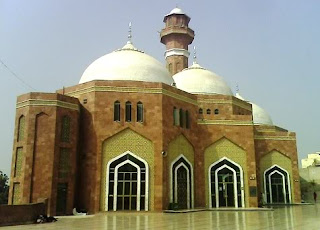
His Mazar Sharif [noble shrine] is in Pak Patan, Pakistan. Hazrat Sabir Pak, Hazrat Nizamuddin Auliya and Hazrat Jamaluddin Hansi rehmatulla alaihim [may Allah have mercy upon them] are among his favourite Murids and Khalifas. It is generally recognized that he had three wives and many children. Hazrat Baba Farid r.a. was indeed one of the most brilliant stars of the Chishtiyya Silsila and is held in high esteem by one and all.

Source: www.ganjshakkar.com

Saturday, 14 July 2012

Abul Hassan Ali Ibn Usman al-Jullabi al-Hajvery al-Ghaznawi\


Daata Sahib Persian/Urdu was a Persian Sufi and scholar during the 11th century. He significantly contributed to the spreading of Islam in South Asia

BackGround.

Ali Hujwiri is both al-Hasani and al-Husayni Sayyid.. His father is al-Hasani Sayyid and his mother is al-Husayni. Abul Hasan Ali bin Usman Al-Hujwiri Al-Jullabi Al-Ghazanwi was born in Ghazni (Hujwir) where his family had settled and the members of which were passionate for devoutness and learning. He was known as Ali Al-Hujwiri Al-Jullabi, Al-Ghazanwi because he lived for a long time in Hujwir and Jullab, the two suburbs (Mazafat) of the city of Ghazni located in Afghanistan. In spite of Hazrat Ali bin Usman Al-Hujwiri's popularity and deep reverence; coming across his life biography is very much tortuous. Much of his life history and thought came from his own authentic reference Revelation of the Veiled

Ali Hujwiri studied Sufism under Abu 'l-Fadl Muhammad, who was a student of Abu 'l-Hasan al-Husri. Abu 'l-Fadl Muhammed bin al-Hasan was well-versed in tafsir and riwayat. Ali Hujwiri traveled far and wide through the Indus to the Caspian Sea. Among the countries and places which he visited were Adharbayajan, the tomb of Bayazid at Bistam, Damascus, Ramla, and Bayt al-Jinn in Syria. In Khursan alone he is reported to have met 300 Sufis Al-Hujwiri was associated with the most well-known Sufi orders in the subcontinent, such as the Qadiri, Suharwardi, Naqshbandi and the Junaidi orders. Hujwiri belonged to the Junaidia school of Sufism, founded by Junaid Baghdadi a major Sufi saint of Baghdad. Hajwiri is also viewed as an important intercessor for many Sufis.Monuddin Chishti Ajmeri, a chief saint of the Chishti order, stated that an aspiring murid (disciple) one who does not (yet) have a murshid (spiritual master), should read Ali Hujwiri's book Kashf al-Mahjub, as that would be (temporarily) enough for his spiritual guidance.[6] He settled for some time in Iraq where he had a short experience with married life.


Ganj Bakhsh-e faiz-e aalam, mazhar-e nur-i Khuda
Naqisaan ra pir-e kaamil, kaamilaan ra rahnuma

گنج بخش فیضِ عالم مظہرِ نورِ خدا
ناقصاں را پیرِ کامل، کاملاں را رہنما

Translation:
Ganj Bakhsh is a manifestation of the Light of God for all people
A perfect guide unto the imperfect ones and a guide unto the perfect ones


In this blog i will provide you the history and biography of  world famous Mazars of  different Peers, Sufia -Ikram, Muhqaq, Shah,.... i also provide you complete address and pictures of these Mazars, so keep visiting   on this blog and  get much more information about this personalities that much closer to God then any other man......